
TPU in Wire & Cable Application
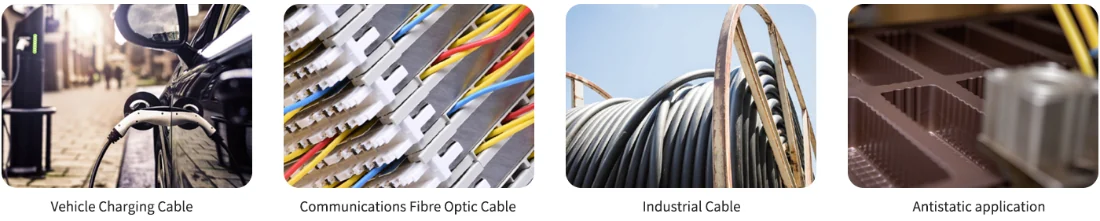
Ten flame-retardant grades for EV charging cables, fiber optic jackets, marine cable and robotics harnesses. Rated from UL94 V-2 to V-0, with halogen-free options for the FR series and a halogenated grade for the highest flame requirement.
Physical properties
| Grade | Hardness | Density | Tensile | Elongation | Tear | Flame |
|---|---|---|---|---|---|---|
| NL1280EV | 83A | 1.19 | 23.5 | 540 | 83 | UL94 V-2 |
| NL8585 | 84A | 1.19 | 37.9 | 508 | 103 | Non-flame-retardant |
| NL8585FR | 85A | 1.23 | 23.6 | 610 | 79 | UL94 V-2 |
| NL1249FRT2BLK | 85A | 1.15 | 35 | 575 | 88 | UL94 V-2 |
| HFR85 | 85A | 1.3 | 24 | 656 | 72 | UL94 V-0 |
| NL1285EV | 86A | 1.19 | 26.5 | 455 | 81 | UL94 V-2 |
| NL1285FR | 87A | 1.21 | 30.9 | 420 | 91.8 | UL94 V-0 |
| NL1250MAT2 | 87A | 1.143 | 39 | 590 | 99 | UL94 V-2 |
| NL1290FR | 88A | 1.21 | 25.3 | 600 | 83 | UL94 V-0 |
| NL1290EV | 89A | 1.2 | 38.9 | 420 | 91.8 | UL94 V-2 |
Complete specifications are per the official TDS — request the current technical data sheet.
What sets it apart
Non-flame-retardant polycarbonate TPU for continuous use at UL105 °C: 37.9 MPa tensile and 103 kN/m tear without halogenated additives.
Marine cable jacket (round or flat): UL94 V-2 with 35 MPa tensile and 88 kN/m tear, salt-spray and UV resistant for dockside exposure.
Halogenated flame-retardant grade for the highest flame requirement: UL94 V-0 with 656% elongation and strong UV resistance. Contains halogen — specify only where the standard requires it.
EV charging cable jacket: fine matte surface, rated −40 to 80 °C, resistant to cracking. Meets GB/T 33594 and EN 50620.
UL94 V-0 at 87 Shore A for robotics cable jackets, where a flame event next to a moving harness is the design case.
Fiber-optic cable jacket: UL94 V-0, IEC 60332-1-2, low shrinkage over thermal cycling and high extrusion speed with no gel particles.
Questions this line raises
Three answers that come up before a grade is chosen — deliberately short. The technical articles go deeper wherever the answer has a mechanism behind it.
Halogen-free or halogenated flame-retardant TPU — which one?
Start from the cable standard, not from preference. The FR series is halogen-free and reaches UL94 V-0 at 87–88 Shore A, on a 1.21 g/cm³ compound. HFR85 is halogenated and reaches V-0 with 656% elongation, for the cases where only a halogenated system passes. The cost is measurable: 1.30 g/cm³ instead of 1.21 is about 7% more compound in every kilometre of jacket. Specify the halogenated grade when the standard demands it, and not as a default hedge.
Why do cable jackets crack two or three years after installation?
Two mechanisms, and both live in the compound rather than in the extruder. Hydrolysis attacks ester bonds, so a polyester jacket on a cable that runs warm and damp loses elongation long before it looks damaged; oxidation and UV attack the surface of whatever backbone is used. Our cable grades are built on aromatic polyether and polycarbonate backbones for that reason — there are no ester bonds to hydrolyse — and the marine grade adds salt-spray and UV resistance for dockside exposure. If a failure is already in progress, measure retained elongation against the original value: a jacket that has lost most of its elongation is at end of life even where it has not yet cracked.
Does TPU have to be dried before processing?
Yes — always. TPU is hygroscopic, and moisture in the melt hydrolyses urethane bonds. The result is not always visible: sometimes bubbles and silver streaks, more often a part that passes inspection on day one and cracks at week six. Dry in a desiccant dryer — typically 80–110 °C for 2–4 hours depending on hardness and the dryer's dew point, with the binding figure taken from the grade's TDS. An oven without desiccant only bakes humid air into the pellets.